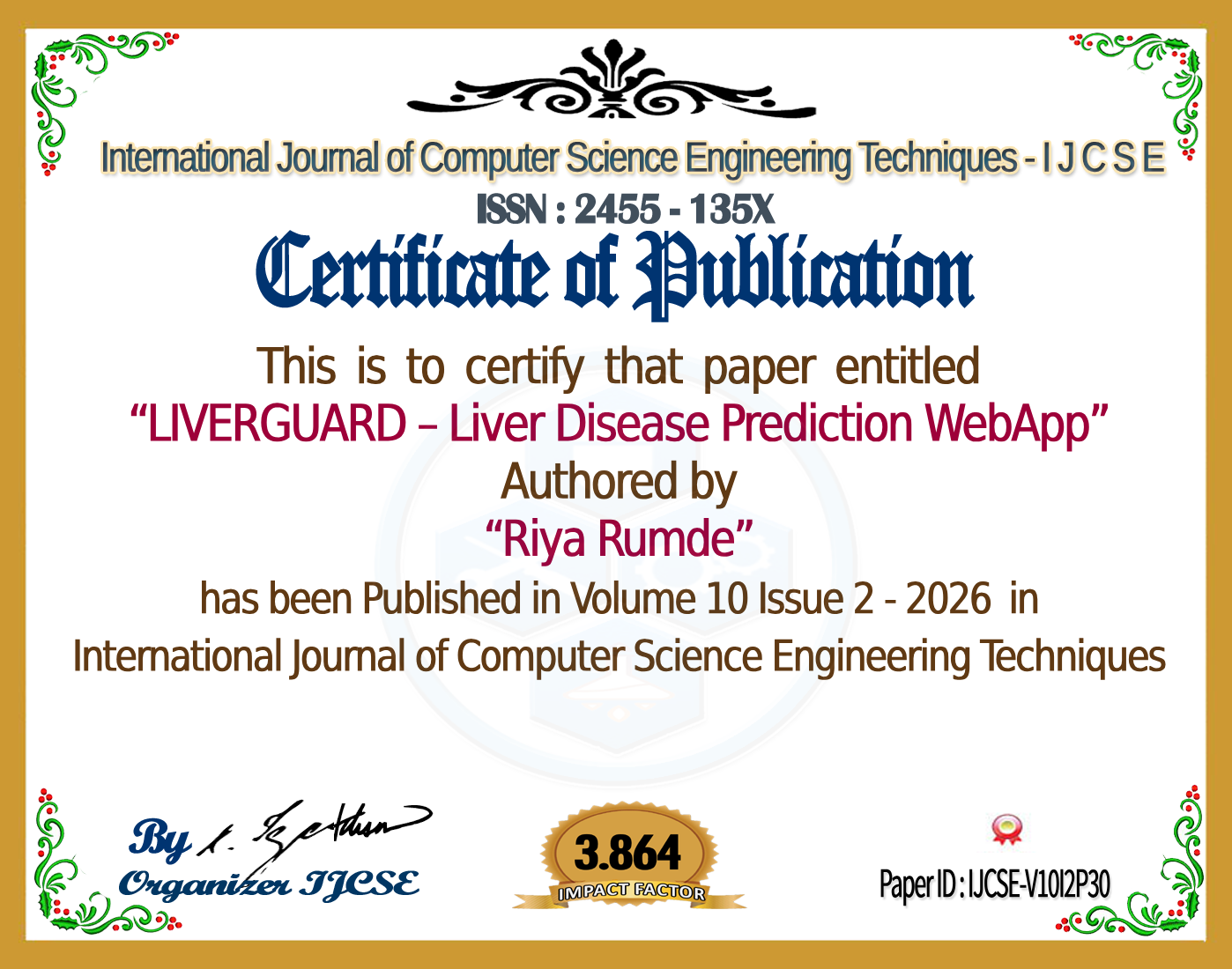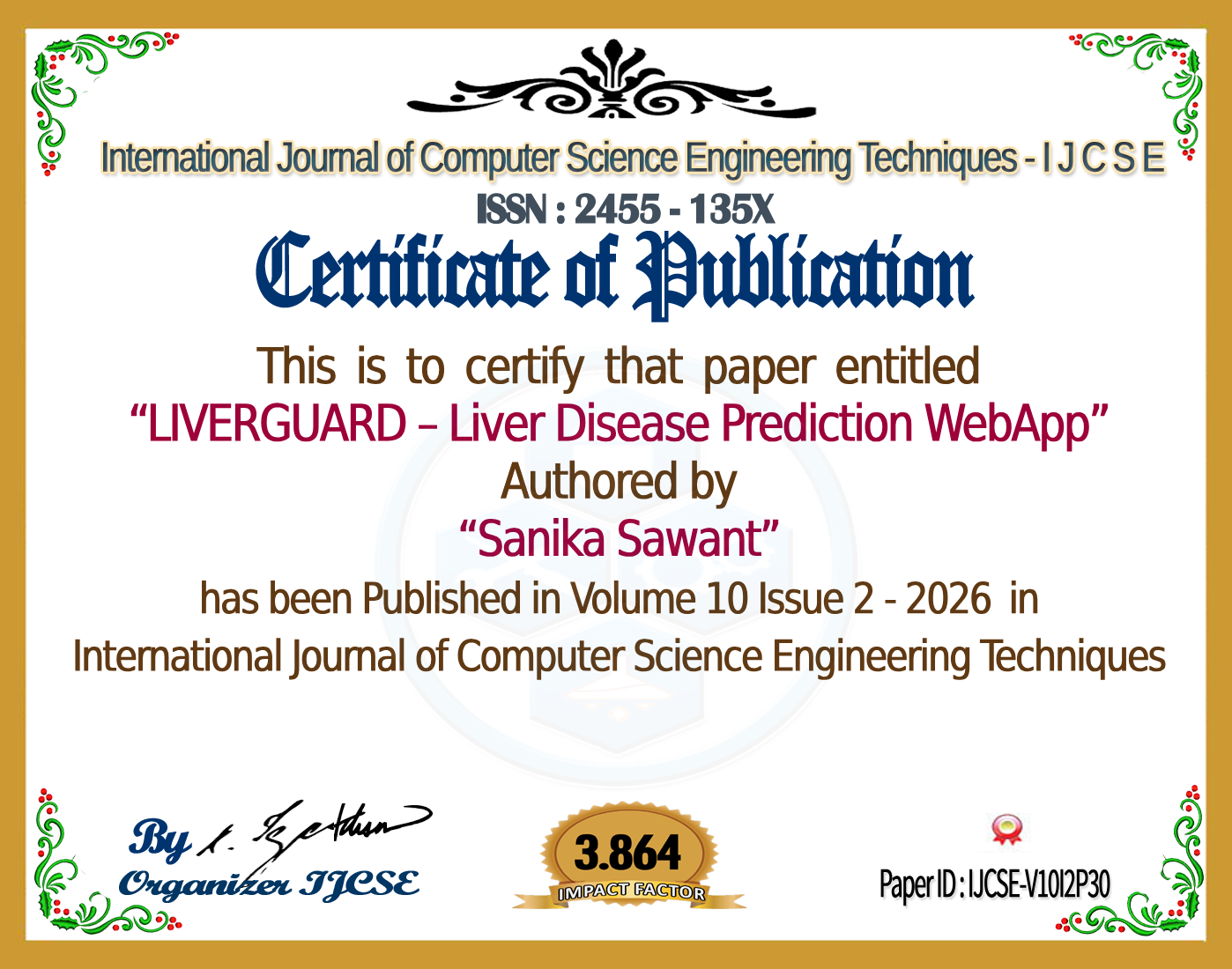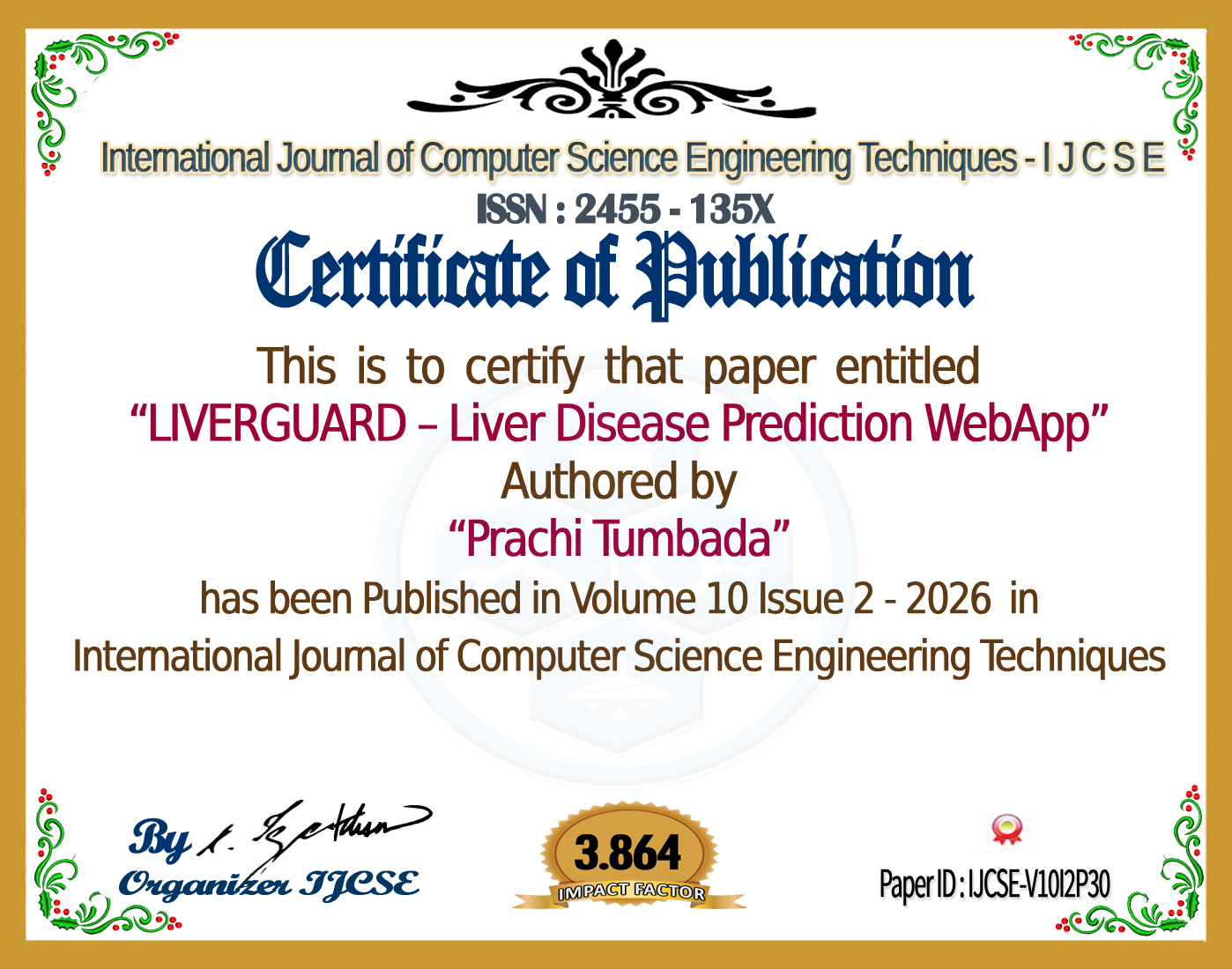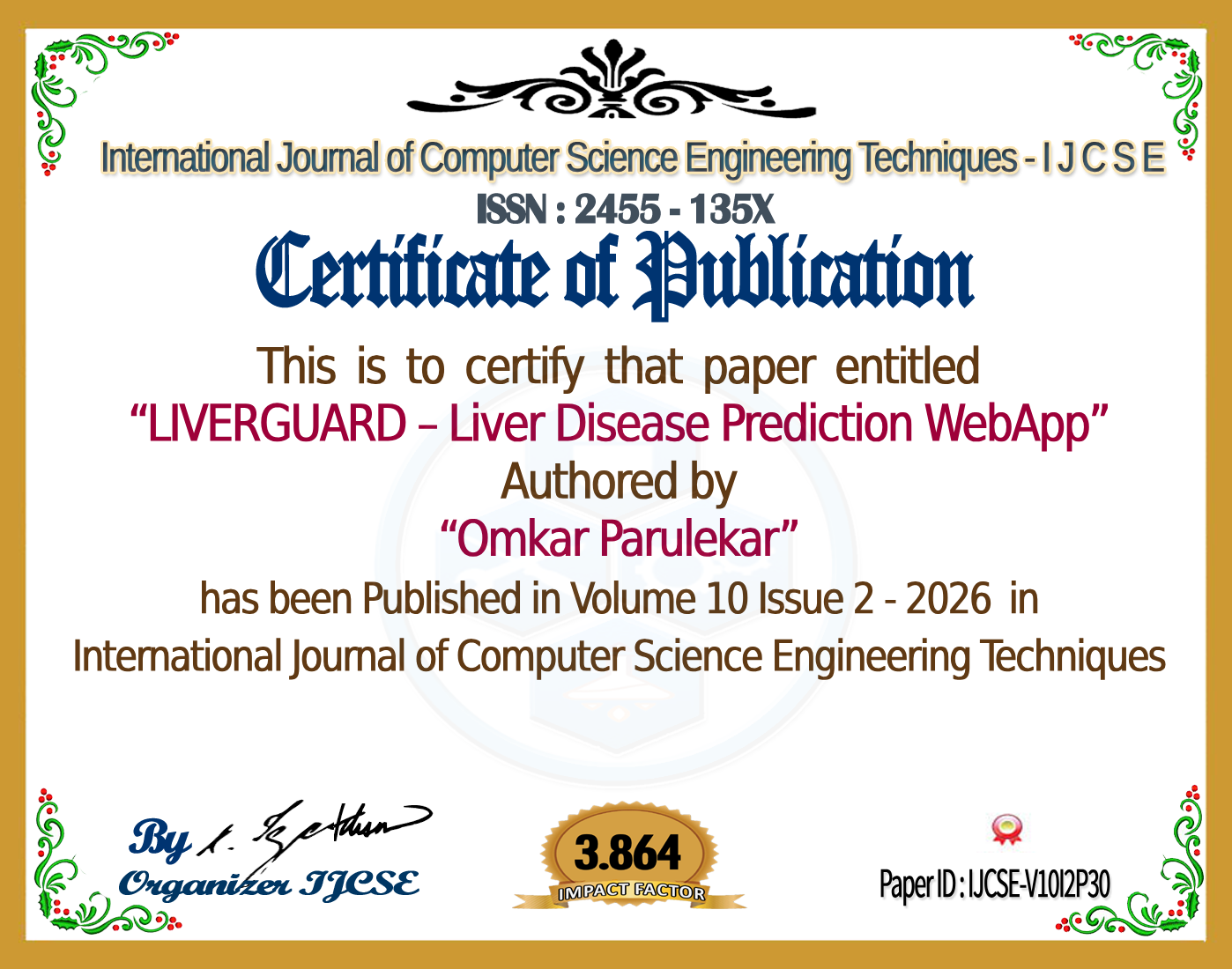
LIVERGUARD – Liver Disease Prediction WebApp | IJCSE Volume 10 – Issue 2 | IJCSE-V10I2P30



Volume 10, Issue 2
|
Published:
Author
Riya Rumde, Sanika Sawant, Prachi Tumbada, Omkar Parulekar
Abstract
With the increasing prevalence of lifestyle-related health problems, liver diseases such as fatty liver, hepatitis and cirrhosis have become a significant global concern. A large number of such cases remain undetected in the early stages due to lack of awareness and limited access to timely diagnostic tools. Many individuals fail to recognize abnormal liver function indicators or ignore the symptoms, which can lead to serious health complications. LiverGuard is a web-based liver disease prediction and awareness platform designed to help users assess their liver health using machine learning techniques. The system analyzes user-supplied medical parameters such as bilirubin levels, enzyme values, and other clinical inputs to predict the likelihood of liver disease. It also provides a liver health score along with personalized recommendations and preventive measures to improve overall well-being. Additionally, the platform includes features such as data visualization, chatbot assistance, and doctor recommendations to increase user engagement and support. LiverGuard aims to create an easy-to-use and accessible system that promotes early detection and encourages proactive health management. The system is developed using modern web technologies such as Flask for backend development, PostgreSQL for database management, and machine learning models for accurate predictions.
Keywords
Liver Disease Prediction, Liver Health Assessment, Machine Learning, Healthcare Analytics, Early Detection, Preventive Healthcare, Web-based Health System.Conclusion
LiverGuard is a web-based liver disease prediction and health assessment system designed to evaluate users’ liver health using machine learning techniques. The platform allows users to input medical parameters, analyzes the data using a trained model, and generates prediction results along with a liver health score and personalized recommendations. The system addresses the growing need for early detection of liver diseases by providing an accessible and easy-to-use tool that helps individuals identify potential health risks. By promoting awareness and preventive healthcare practices, LiverGuard assists users in understanding their health condition and encourages timely medical consultation. The project demonstrates how modern web technologies and machine learning can be effectively combined to develop intelligent healthcare solutions. In the future, the system can be enhanced by incorporating advanced features such as real-time health monitoring, integration with healthcare APIs, improved model accuracy using deep learning techniques, and multilingual support for wider accessibility. With further development, LiverGuard has the potential to be implemented in healthcare institutions and used as a supportive tool for early screening and health awareness among the general population.
References
1.F. Mostafa, E. Hasan, M. Williamson, and H. Khan, “Statistical machine learning approaches to liver disease prediction,” Livers, vol. 1, pp. 294–312, 202
2.E. Dritsas and M. Trigka, “Supervised machine learning models for liver disease risk prediction,” Computers, vol. 12, p. 19, 2023.
3.A. Sivasangari et al., “A comparative study on liver disease prediction using supervised learning algorithms with hyperparameter tuning,” International Journal of Novel Research and Development, vol. 7, 2022.
4.A. Alizargar, Y. -L. Chang, and T. -H. Tan, “Performance comparison of machine learning approaches on hepatitis c prediction employing data mining techniques,” Bioengineering, vol. 10,
p. 481, 2023.
5.M. Alauthman, A. Aldweesh, A. Al-qerem, F. Aburub, Y. Al-Smadi, A. M. Abaker, O. R. Alzubi, and B. Alzubi, “Tabular data generation to improve classification of liver disease diagnosis,” Applied Sciences, vol. 13, p. 2678, 2023.
6.J. Singh et al., “Prediction of liver disease with machine learning: A comparative study,” JETIR, vol. 8, 2022.
7.S. Gupta et al., “Deep learning approaches for liver disease diagnosis based on ultrasound images,” Journal of Medical Systems, 2021.
8.M. Trigka et al., “Hybrid approaches to improve liver disease prediction using data imbalance techniques,” Computers, vol. 12, p. 481, 2023.
9.R. -H. Lin et al., “Predictive models for chronic liver disease using decision trees and boosting algorithms,” IEEE Xplore, 2021.
10.G. Shobana et al., “Ensemble learning techniques for liver disease diagnosis,” ACM Digital Library, 2022.
11.K. Saini and A. Goyal, “Role of machine learning in early detection of liver disease: A systematic review,” International Journal of Medical Informatics, 2020.
12.A. Alizargar et al., “Applying neural networks to improve liver disease prediction accuracy,” Computers, vol. 12, 2022.
J. Singh et al., “Comparative analysis of ml algorithms for liver disorder diagnosis using real-world dataset,” PubMed, 2021.
Related Posts: