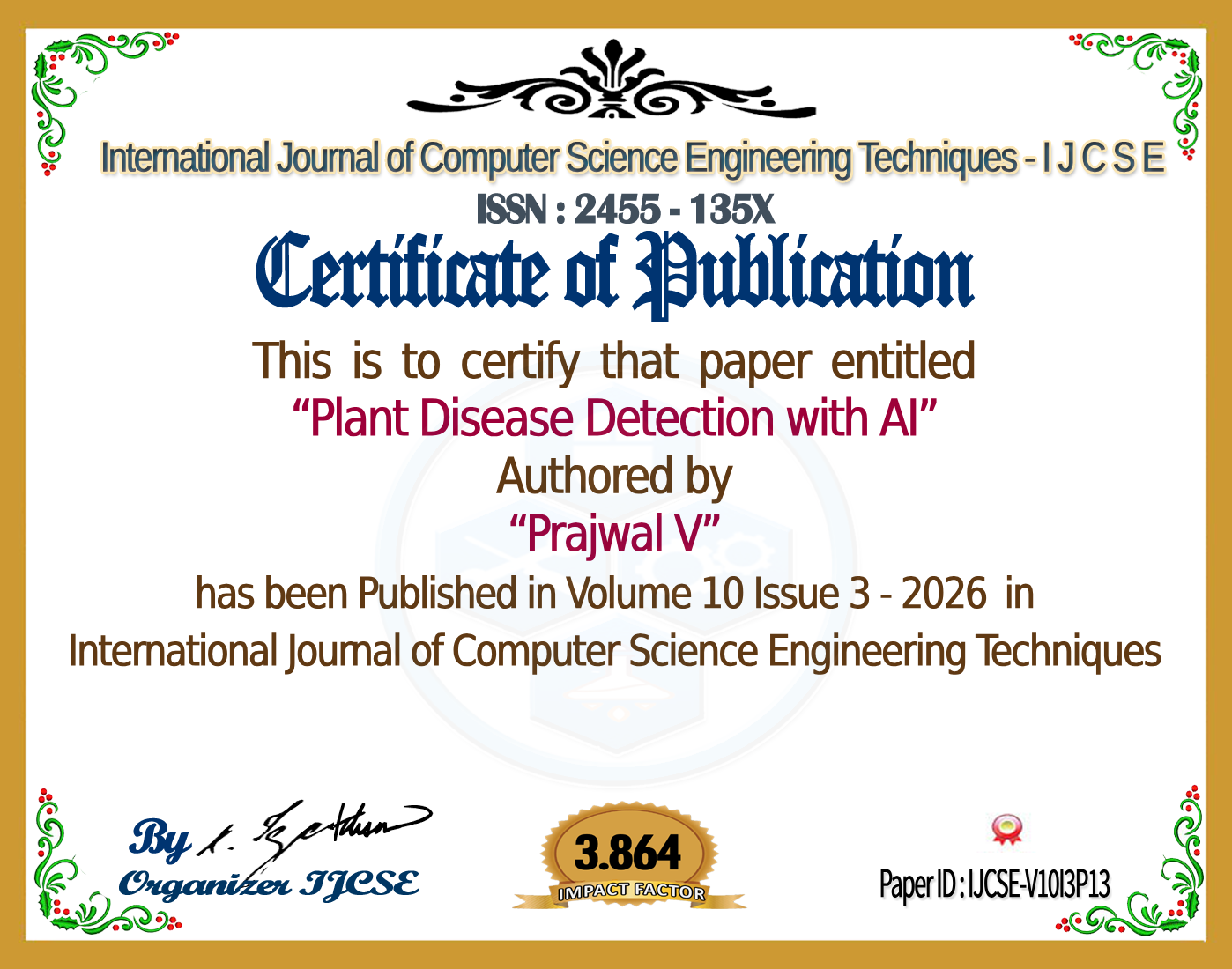
Goutham B, Kavitha A S, Jainth Kumar L, Kruthik Kumar k, Prajwal V
Abstract
Plant diseases significantly affect agricultural productivity and food security across the world. Traditional disease detection methods rely heavily on manual inspection by agricultural experts, which is time-consuming, expensive, and less effective for large-scale farming. Artificial Intelligence (AI), especially Deep Learning and Convolutional Neural Networks (CNNs), provides an automated and accurate approach for detecting plant diseases from leaf images. This research paper presents an AI-based plant disease detection system using CNN architecture for identifying diseases in crop leaves. The proposed system uses image preprocessing, feature extraction, classification, and prediction to detect diseases at early stages. Public datasets such as PlantVillage are used for training and testing. The proposed model achieves high accuracy and provides real-time disease prediction support for farmers through mobile or web applications. The study concludes that AI-based systems can improve agricultural productivity, reduce crop loss, and support smart farming practices
Keywords
^
Conclusion
The AI-based Plant Disease Detection System provides an efficient and accurate solution for identifying plant diseases using deep learning techniques. The CNN model successfully classified plant diseases with high accuracy and reduced manual effort in agricultural monitoring.The project demonstrates that Artificial Intelligence can improve agricultural productivity by enabling early disease detection and proper crop management. The system supports smart farming practices and helps farmers reduce economic losses caused by plant diseases.The experimental results confirm that the proposed system is reliable, fast, and effective for automatic plant disease identification. With future enhancements such as mobile deployment and IoT integration, the system can become more practical for real-world agricultural applications.
References
1.Mohanty, S. P., Hughes, D. P., & Salathé, M. “Using Deep Learning for Image-Based Plant Disease Detection.” Frontiers in Plant Science, 2016.
2.Ferentinos, K. P. “Deep Learning Models for Plant Disease Detection and Diagnosis.” Computers and Electronics in Agriculture, 2018.
3.Too, E. C., Yujian, L., Njuki, S., & Yingchun, L. “A Comparative Study of Fine-Tuning Deep Learning Models for Plant Disease Identification.” Computers and Electronics in Agriculture, 2019.
4.Brahimi, M., Boukhalfa, K., & Moussaoui, A. “Deep Learning for Tomato Diseases Classification.” IEEE Access, 2017.
5.Sladojevic, S., Arsenovic, M., Anderla, A., Culibrk, D., & Stefanovic, D. “Deep Neural Networks Based Recognition of Plant Diseases by Leaf Image Classification.” Computational Intelligence and Neuroscience, 2016.
6.LeCun, Y., Bengio, Y., & Hinton, G. “Deep Learning.” Nature, 2015.
7.Krizhevsky, A., Sutskever, I., & Hinton, G. “ImageNet Classification with Deep Convolutional Neural Networks.” NIPS, 2012.
8.Simonyan, K., & Zisserman, A. “Very Deep Convolutional Networks for Large-Scale Image Recognition.” ICLR, 2015.
9.Howard, A. G., et al. “MobileNets: Efficient Convolutional Neural Networks for Mobile Vision Applications.” Google Research, 2017.
He, K., Zhang, X., Ren, S., & Sun, J. “Deep Residual Learning for Image Recognition.” CVPR, 2016.