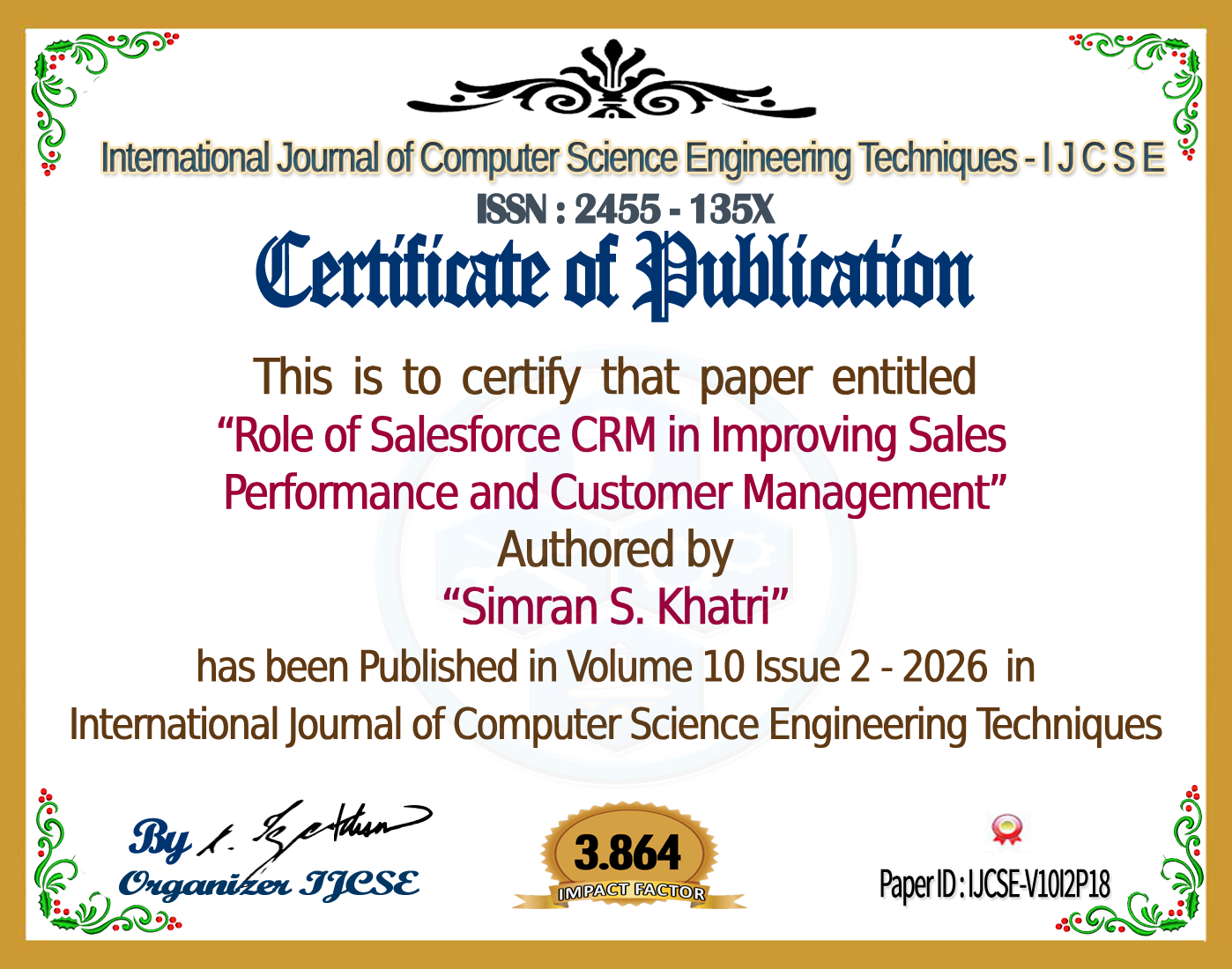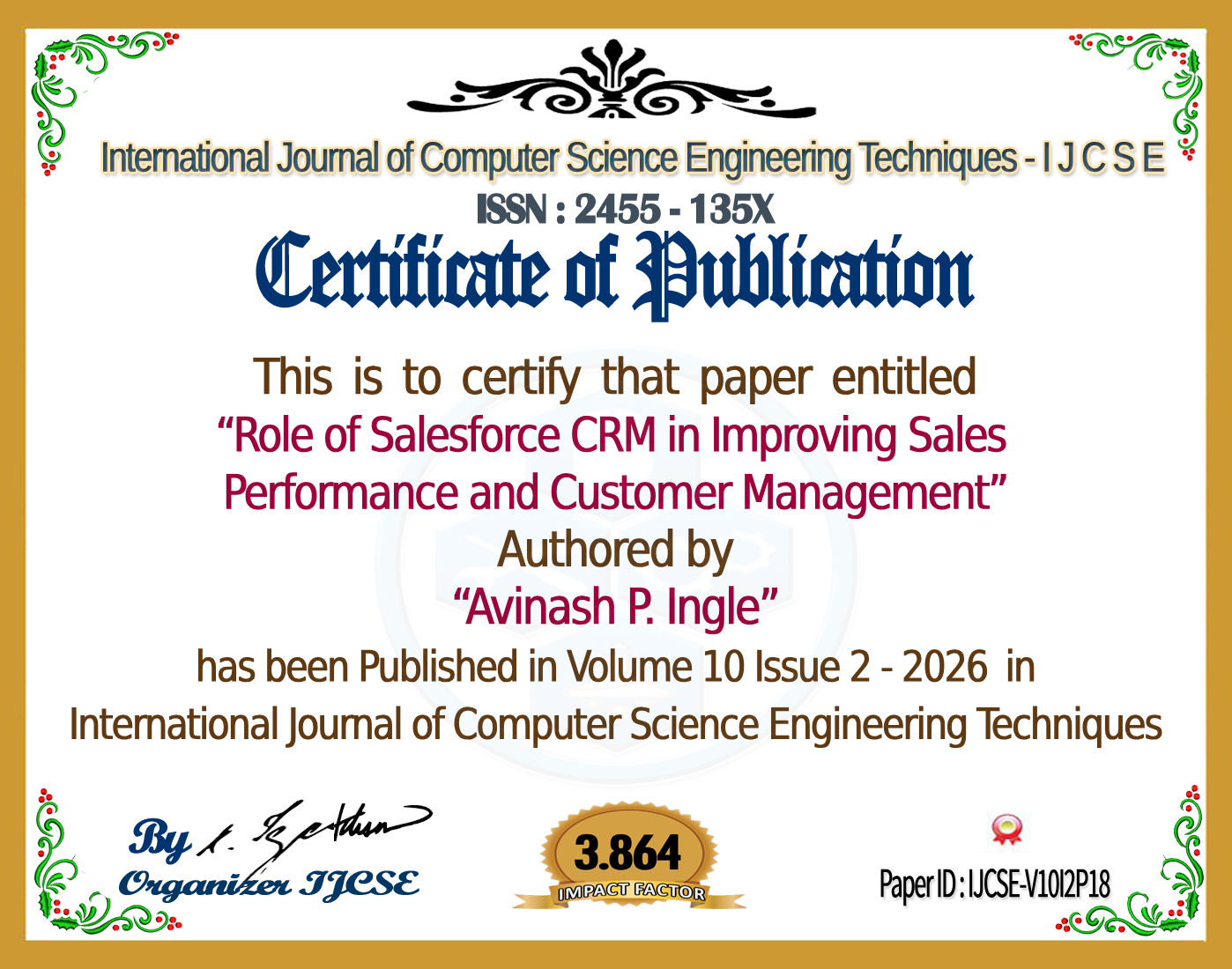
Role of Salesforce CRM in Improving Sales Performance and Customer Management | IJCSE Volume 10 – Issue 2 | IJCSE-V10I2P18


Volume 10, Issue 2
|
Published:
Author
Simran S. Khatri, Avinash P. Ingle
Abstract
In the modern business environment, managing customer relationships effectively and improving sales performance are key priorities for organizations. With increasing competition and large volumes of customer data, traditional methods of tracking sales and customer interactions are no longer sufficient. This has led to the adoption of advanced Customer Relationship Management (CRM) systems such as Salesforce, which provide a centralized platform for managing business processes. This paper examines the role of Salesforce CRM in enhancing sales performance and improving customer management practices. It focuses on how features such as lead management, opportunity tracking, automation tools, and reporting capabilities help organizations streamline their sales processes and maintain better relationships with customers. A practical approach is considered to understand how businesses can use Salesforce to organize customer data, monitor sales activities, and identify growth opportunities. The study highlights that Salesforce CRM enables sales teams to work more efficiently by reducing manual tasks and providing real-time access to important information. It also helps in understanding customer needs and behavior, allowing organizations to offer more personalized services. Furthermore, the use of dashboards and reports supports better decision-making by presenting clear insights into sales trends and performance metrics. Overall, the paper concludes that Salesforce CRM plays a significant role in improving both sales outcomes and customer satisfaction. By integrating data, automation, and analytics into a single platform, it supports organizations in achieving better productivity and long-term business growth.
Keywords
Salesforce CRM, Customer Relationship Management, Sales Performance, Customer Management, Lead Management, Opportunity Tracking, Business Automation, Data Analytics, Sales Optimization, Customer EngagementConclusion
In this study, the role of Salesforce CRM in improving sales performance and customer management was examined through a practical approach. It was found that Salesforce provides an effective platform for managing customer data, tracking sales activities, and generating meaningful insights.
The use of reports and dashboards played a major role in simplifying complex data and presenting it in an easy-to-understand format. Features such as order tracking, revenue analysis, and customer segmentation helped in better decision-making and improved overall efficiency. By using these tools, organizations can quickly identify strengths and weaknesses in their business processes.
In addition, Salesforce CRM supports better customer management by maintaining organized records and enabling personalized communication. This leads to improved customer satisfaction and long-term relationships. The automation features further reduce manual work and increase productivity.
In conclusion, Salesforce CRM proves to be a valuable tool for modern businesses. Its ability to combine data management, analysis, and visualization in one platform makes it highly effective for improving both sales performance and customer relationships. Organizations that effectively use Salesforce can gain a competitive advantage and achieve sustainable growth.
References
[1] S. Kumar and A. Reinartz, Customer Relationship Management: Concept, Strategy, and Tools, 3rd ed. Berlin, Germany: Springer, 2021.
[2] P. Harrigan, M. Miles, Y. Fang, and T. Roy, “The role of social media in customer relationship management,” J. Business Research, vol. 128, pp. 1–12, 2021.
[3] A. Choudhury and P. Harrigan, “CRM to social CRM: The integration of new technologies into customer relationship management,” J. Strategic Marketing, vol. 29, no. 6, pp. 1–15, 2021.
[4] R. A. Keramati, M. Mehrabi, and N. Mojir, “A process-oriented perspective on customer relationship management and organizational performance,” Business Process Management J., vol. 27, no. 2, pp. 1–20, 2021.
[5] M. Sigala, “Customer engagement and CRM in digital environments,” Int. J. Hospitality Management, vol. 94, 2021.
[6] (2025) Salesforce official website. [Online]. Available: https://www.salesforce.com/
[7] (2024) Salesforce CRM features and solutions. [Online]. Available: https://www.salesforce.com/in/crm/
[8] S. Verhoef, T. Broekhuizen, Y. Bart, and A. Bhattacharya, “Digital transformation: A multidisciplinary reflection and research agenda,” J. Business Research, vol. 122, pp. 889–901, 2021.
[9] M. Wamba-Taguimdje, S. Fosso Wamba, J. Kala Kamdjoug, and V. Tchatchouang Wanko, “Influence of artificial intelligence on firm performance,” J. Business Research, vol. 140, pp. 103–115, 2022.
[10]D. Chaffey and F. Ellis-Chadwick, Digital Marketing, 8th ed. Harlow, U.K.: Pearson, 2022.
[11] A. Payne, P. Frow, and A. Eggert, “The customer relationship management process: Its measurement and impact,” J. Marketing Management, vol. 37, no. 5–6, pp. 477–506, 2021.
[12] M. Buttle and S. Maklan, Customer Relationship Management: Concepts and Technologies, 4th ed. London, U.K.: Routledge, 2022.
Related Posts: